Pages

Showing posts with label london. Show all posts

Tuesday, 29 March 2022

London Music History Walks

This is part of a series of walking videos I have been making in which I visit significant locations in the musical history of London.

First up, I visited Eel Pie Island in Twickenham.


Wednesday, 16 December 2020

Revisiting Hanworth's Largest Outdoor Street Art Gallery 2020


It may not be the lanes of Melbourne or the east end of London, but I keep returning to the stunning work being produced in this outdoor space beside a crematorium in south west London.


Most appealing to me is the large number of artists incorporating characters into their work.


Some are far more reminiscent of cartoons than "traditional" graphotism with its elaborate sense of design.


Tuesday, 19 May 2020

An Englishman in the East

Born in London, England in 1910, and winning a scholarship to Chigwell School as a child, during his lifetime the British journalist and novelist Alan Winnington would travel the world.
As a young man, following a chance meeting with Harry Pollitt in a pub in 1934, he joined the Communist Party of Great Britain, and he soon became a branch secretary. His career in journalism began when he landed a job with a photo agency, and soon he was writing for socialist newspapers like the Daily Worker (as the Morning Star was known at the time) which he continued to write for from the 1940s up until the 1960s. For the first few years after WW2 he became “our man in Beijing”, when he reported on the early years of the newly independent People’s Republic of China for the Daily Worker, while also working as an advisor to the new Xinhua (New China) news agency.

Uncomfortable Truths
His location in Asia meant he was ideally placed to report on the Korean war when it broke out in June 1950, and he would anger his own government by reporting on both the Korean and later the Vietnam wars from the communist side. Along with his colleague, the Australian journalist Wilfred Burchett (who was equally ostracized for his reporting by his own birth country), Winnington would expose the use of biological weapons against Koreans by the USA.
For this brave reporting both men had their passports removed for many years.

From China to Germany
By 1960 Winnington had learned to speak Chinese fluently, but had already become skeptical of Mao’s approach to building socialism at least two years earlier because of the "Great Leap Forward" and other campaigns, which he described as “stupidities.” He left China with his Sino-British wife Esther and their two children, settling in East Berlin while they attempted to negotiate the return of his British passport with the help of Lance Samson, a German Jew who also worked for the Star.
The British government were still considering a charge of treason or espionage, possibly with a death sentence, as punishment for his reporting during the Korean war, so even after the restoration of his passport he did not return permanently to his country of birth, choosing instead to remain in Berlin. Sadly, his wife wanted to return to Britain, and their marriage broke down when she decided to move with their two children back to Britain, where she married Samson with whom she had a third child. Their daughter Polly would subsequently grow up to become an author in her own right.
After making the decision to remain in the east, Winnington began a new family with a lady named Ursula Wittbrodt, who he had met in 1963 and who would become Ursula Winnington when they married in 1967. He did not receive his British passport until a year later. (Burchett had to wait until Gough Whitlam’s Labour government came to power in 1972 before his birthright was restored.)
Winnington continued to work as a correspondent for the Morning Star from his new home in the GDR, and also served at times as an Asia advisor to the East German government. During the Vietnam War he repeatedly had the opportunity to travel to the Far East where he reported from both China and Vietnam.

From Journalism to Crime Writing
Alongside his journalistic work however, Winnington was increasingly beginning to develop a career as a novelist and author of crime fiction, among them novels in German like Heart failure, Inspector Gullet and The Death Curve, The Presumed Dead Man and Angler's Alibi. He also wrote children's books, such as a fantasy novel in two volumes about a robot horse called "Silver hoof", which was set in the Himalayas. During his time in China, he had developed a considerable love and admiration for the people of Tibet, writing Tibet: Record of a Journey (1957), which these stories reflected.
He even had a very brief foray into acting, appearing in a small film role as a Chief of Intelligence Service in the 1967 East German film Die Gefrorenen Blitze (Frozen Flashes), although he seems to have enjoyed more success with writing. His crime novel Police Alibi was made into a film for East German television in 1971 (Tod in der Kurve), while Milliony Ferfaksa (Fairfax’s Millions) was turned into a feature film in 1980 by the Russian Dovzhenko Film Studios.
His autobiography Breakfast with Mao was first published in a small German print run, as he had still been writing it when he died on 26th November 1983. Described by the historian Edwin Moise in the London Review of Books as “marvellously readable” it only appeared in English in 1986 when Lawrence and Wishart published it as From London to Beijing: Memoirs of a Foreign Correspondent 1914 to 1960.
Nine short novels, six of which belong to the crime and detective genre, the aforementioned two children's books and four travel books about China and Asia have also been published in English at some time or another. Yet despite this diverse oeuvre it appears that Slaves of the Cool Mountains remains the only one of his books currently still in print in the English language, and he currently has no English language Wikipedia entry.
Today Ursula Winnington is mainly known in Germany as an author of cookbooks, where she has been called the “Chef Queen of the East”, with some of her books reaching a total circulation of over one million copies, including her Kleines Kochbuch für Kinder (Small Cookbook for Children) (1977). Since 1992, Klatschmohn Verlag has reissued three of her most popular books, and in 2008 she published another book Liebe, Lust und Leckereien (Love, Lust and Treats). In 1995, long after Winnington’s death in 1983 and the reunification of Germany in 1990, she opened The Gecko in Berlin, a shop for exotic furniture and gifts from all over the world, and continues to make her home in Berlin.

Revival of Interest from Korea
Alan Winnington remains almost unknown in the country of his birth, and the English speaking world more broadly. Unlike Burchett, who is mainly remembered for his Daily Express article of 1945 which exposed the reality of nuclear radiation sickness following the atomic bombing of Hiroshima and Nagasaki, Winnington does not even have an English language Wikipedia entry. He is remembered, it seems, only in Germany.
With this in mind it is therefore quite noteworthy that recently the media organisation Ahim and South Korean journalist Im Hyoin have been bringing Winnington’s revelations about US atrocities in Korea to light once more, if only in South Korea, among them Winnington’s work exposing the notoriously under-reported Sincheon massacre. This atrocity even inspired a painting by Picasso which sits in the Picasso Museum in Paris. It is a painting as stark and brutal as his earlier painting Guernica inspired by fascist atrocities in the Spanish Civil War but which still remains far less well known. 

This should give us pause to reflect upon how, thirty years after the Cold War ended, its logic continues to distort our own historical memory.

Notes:


Friday, 1 May 2020

The Longford River at Feltham


The Longford River flows through south west London. Its path is not entirely natural, having been canalised at various stages and engineered to flow downhill in order to feed the majestic Diana Fountain in Bushy Park. It flows through various landscapes on its journey, including skirting the southern edge of Heathrow Airport and making its way through Feltham and Hampton.

So many local artists use Bushy Park as a source of inspiration for their landscape art that I wanted to focus some attention on the more overlooked landscapes through which the river passes, like this stretch of the river as it flows from Bedfont towards Feltham town centre, hinted at by the buildings on the horizon.

If you like it there are a variety of forms for you to own it available through my Red Bubble page.

Tuesday, 18 September 2018

Hanworth's largest outdoor (unofficial) Street Art Gallery

An unofficial gallery of street art can be found in a derelict train yard. The site itself has been re-colonized by wilderness over the years, and recently has found itself slowly being transformed into an official Nature Reserve between Pevensey Road, Hanworth and South West Middlesex Crematorium.

Here are a few examples of the works on display by local artists. As is traditional, new works are painted over old. Presently you will find a nice mix of figurative and typographic. I'm afraid I do not know any of the artists whose work is presently on display, as I only became aware of the unofficial outdoor gallery when first attempting to walk the full Crane Valley, and I would caution anyone seeking to view the art in person to be careful as there is a lot of broken glass on the ground. Presumably some kind of interactive conceptual piece using found objects...


Friday, 15 December 2017

Walking the Crane Valley, Part 2

About a year and a half ago Pevensey Road Nature Reserve, on the border between Hanworth (in the London Borough of Hounslow) and Heathfield (in the London Borough of Richmond) was so overgrown, its paths so ill-defined, that it was almost impossible to find a comfortable way through. It is still a spectacularly wild stretch of woodland, but over several months has been transformed (largely through the efforts of local volunteers), making its main pathway far easier to walk, and sunlight now able to reach low-growing plants.


The wilderness at Pevensey Road Nature Reserve matches that found along stretches of the Crane Valley to the north (covered in part one)


The results of recent volunteer efforts is clearer paths and better light

A "Green Gym" is held here most Mondays, where locals can get involved in maintaining this remarkable stretch of land which allows people to walk from Feltham to Hanworth Road through a landscape of relative tranquillity, away from the noise of some of the other main roads in the area. Hanworth Road itself is relatively busy, but a zebra crossing connects the walker from Pevensey Road Nature Reserve to Crane Park beyond. 


The River Crane, looking east from Hanworth Road at dawn

Crane Park is one of the most well-managed stretches of the whole Crane Valley. Its paths are wide and flanked by a cathedral of trees, home to a whole range of birds and wildlife. It is possible to walk the river on the north or the south side. On the north side of the Crane, the paths are tarmac and maintained by Richmond council, while on the south they are sandy but still good, and maintained by Hounslow council. The quality of the pathways makes this stretch of the Crane Valley the easiest for cyclists to ride too, although it is predominantly the preserve of dog walkers.


Sections of the park, such as the island at the centre, are maintained by London Wildlife Trust as a nature reserve. In other parts of Crane Park efforts have been made to restore a more natural character to the banks of the river (see above), reducing the effect of 'canalising' to create a better habitat for wildlife like water voles.


Just like at Donkey Woods, there are remnants of the areas' gunpowder industries on both the north and south side of the park. The picture above shows how much better this stretch of woodland is managed in comparison to the one taken at Donkey Woods that I used in Part 1 of this piece.

  
You can see the effects of 'canalising' as the river flows east. This photo was taken on the footbridge close to Mill Road, Twickenham.


The Chertsey Road is a loud dual carriageway that slices up this beautiful stretch of wilderness much as the Great South West Road does further north. However, if you stick to the north side of the river while walking through Crane Park the two underpasses enable you to walk seamlessly from one side of the road to the other. The photo featured above was taken not far to the east of the Chertsey Road in late summer, and I hope goes some way to conveying what an oasis of tranquillity this region is once you allow yourself to walk mere yards from the road.


Crane Park narrows somewhat as you follow the river east to Twickenham, and after crossing a small road you soon arrive at Kneller Gardens. This fairly modest sized outdoor space has been incredibly well equipped in recent years with a children's playground, tennis courts, free outdoor gym, cafe with drinking fountain, lots of benches, and not one but two foot-bridges that take you across the river (see above), which bisects for the first time since the Duke of Northumberland's River joins the Crane at Donkey Woods.
I remember this area back in the 90s as something of a forgotten wasteland. In fact, it had once been allotments which had fallen into dis-use and been closed by the council. Today the land has been revived as Mereway Nature Reserve, with beautifully carved benches and an area of open wilderness that is far better managed than before. While you probably have about the same chance of seeing foxes darting through the fence to railway land as before, there is now a far greater chance of foraging for blackberries and rose hips which grow freely here than just nettles.
You can follow the river somewhat sporadically as it passes alongside the railway lines and along the side of the increasingly better landscaped paths that skirt the outskirts of the once quite empty Craneford Playing Fields, at which point you will have to make a somewhat wider diversion around the houses before you can reconnect with the river beyond the rapidly renovating Twickenham railway station. The final spot along the river where you can comfortably stop before it joins the Thames at Isleworth is at Moor Mead Gardens in St Margarets.


Life along the River Crane at Twickenham

Friday, 1 December 2017

Walking the Crane Valley, Part 1


Just to the south of the Grand Union Canal's Paddington Branch and Bulls Bridge, running parallel to the busy Parkway dual carriageway, is a small unobtrusive river flanked by woods called the Crane. At various points along its journey its natural path has been altered by human development – through pollution and some canalising – and its identity is sometimes hard to determine, but it remains one of the most natural rivers in London. To the north of the Grand Union Canal the river which feeds the Crane is called Yeading Brook, which begins its journey in Harrow.
The entrance to Cranford Country Park in autumn, 
viewed from the bridge over the River Crane
If you leave the busy Cranford Parkway Interchange on the south-west of the roundabout and take a small slip road tucked between the Parkway and the M4 motorway you will find the main entrance to Cranford Country Park, which technically is part of the neighbouring Borough of Hillingdon. At this point the river itself follows the boundary between the west London boroughs of Hounslow and Hillingdon, flanked by Avenue Park on the east side and Cranford Park on the west.
Nothing remains of the old manor house, the former residence of the Berkeley family, which was demolished in 1945. However within the grounds of the park you will find the small parish church of St Dunstan's, which dates from the 15th century and remains in use to this day. One quite notable thing about St Dunstan's, apart from its understated charm, is that it contains the interred ashes of the late comedy actor Tony Hancock.
Along the banks of the River Crane, viewed from the Cranford Park side
Perhaps the most unfortunate thing that history has inflicted upon Cranford Park is that, with the construction of the M4 motorway in the late 1950s, this beautiful expanse of land was effectively sliced in two. A small underpass behind St Dunstan's called Dog Kennel Covert connects walkers and cyclists to the northern section, which tracks the Crane north to where it intersects with the Grand Union Canal, while the vast majority of the park lies to the south of the motorway.
A footbridge over the River Crane, viewed from the Avenue Park side
It is this southern portion that makes for the most pleasant walking experience, with well maintained paths and a small iron footbridge which allows you to cross the river from Cranford Park to Avenue Park in neighbouring Hounslow. If you would prefer, you can follow the river quite easily as you walk south along the Hillingdon side, and as you walk you may catch sight of nuthatches and other small birds like the meadow pipit that have been spotted in this area, swooping across the wide open stretches beyond the thickly wooded section along the river itself. You may be more likely to see the giant metal birds taking off from the airport to the south west.
Berkeley Meadows in summer
A small road separates the broad expanse of Cranford Park from a smaller but perfectly formed park called Berkeley Meadows, which was once an area of marshy damp meadows used for grazing sheep and cattle, but which today has a good path, easy access to the river as it flows south, and a well maintained children's playground. It is now home to a wide range of wildlife including butterflies, birds, mammals and insects, and you may even glimpse the Kingfisher flying up and down the river. 
Beyond here we encounter our first challenge to our Crane Valley walk in the form of Bath Road, a noisy dual carriageway which forces a small detour east to where there are traffic lights. I find the practical benefit of the shops and supermarkets in Cranford (Indian, Polish and Tesco) make up for the inconvenience of the noise and detour.
A path leads from the river to Huckersby Meadows in Cranford
Recent developments have made it difficult to access the Crane directly from Bath Road, so its necessary to cut through Waye Avenue, a circular suburban street with access to a playing field at the southern end. From this field you can cross another small iron bridge across the Crane to the newly opened Huckersby Meadows, which has been revived by the London Wildlife Trust from a former car park and wasteland into a large stretch of land where cows now graze.
Huckersby Meadows is bordered to its west by Heathrow Airport's Eastern Perimeter Road, so if you want to follow the Crane further south it is better to stay on the east side and follow the path through Cranebank Park. This is well maintained with benches and information boards about the local non-human inhabitants, and as you walk you find yourself entering an oasis of remarkable peace and tranqillity, bar the periodic aircraft passing overhead.
The abundance of natural flora and fauna comes as quite a surprise given the highly urbanised environment of Hounslow, so the fact that you can find here an environment supporting a range of mammals like foxes, rabbits, weasels, moles and bank voles is remarkable. The very best time to walk this stretch of the river is in the warm dry months from May to September, as the southern part of the land can be prone to flooding in winter.
The benches along Cranebank make life easier for local artists
The Great South West Road presents the next challenge to anyone wanting to walk the Crane Valley in its entirety. It is a wide dual carriageway which also runs parallel to the Piccadilly line as tube trains briefly emerge into the light before reaching their final destination of Heathrow. The only way that presently exists to get to the south side of the road are traffic lights down at the junction with the A312 to the east. On the plus side it is worth reminding yourself that this is the most dramatic detour you will encounter throughout the whole of this route.
Having crossed the roaring danger of the Great South West Road you will be able to locate the Crane again by finding the entrance to the Causeway Nature Reserve beside an imposing advertising billboard. 
Winter sunlight through trees on the Causeway
The Causeway is a small but welcome respite from the surrounding roads and industrial estates of Hatton and North Feltham, a place where you can find damp-loving herbs such as Meadowsweet and Gipsywort growing amongst the grasses, and a cover for many small birds such as the blackcap or whitethroat.
Also, thanks to a well placed underpass, you can walk easily and safely south to the longer stretch of woodland which lies beyond known as Donkey Woods. Here you will encounter the first remnants of the local gunpowder industries that once filled the river with toxic pollutants. Just remember to wear your wellies. It can get muddy. Alternatively, as with Cranebank, you may wish to tackle it only in the warmer, dryer months of the year.
The view east from the raised boardwalk through Donkey Woods in late summer

The northern section of Donkey Woods has a raised boardwalk to take you across the wettest, widest section of the River Crane, while the southern section is easier to walk throughout the year. It is here, in amongst often dense woodland, that you will find the remnants of Hounslow's gunpowder industries of the past, and where the Duke of Northumberland's river also intersects with the Crane.

A remnant of one of the gunpowder factories, 
now reclaimed by nature and local graffiti artists
When you reach Staines Road at the end of Donkey Woods a crossing to your right will take you safely across the street to the shops and petrol garage, and it is behind this petrol garage that the entrance to Brazil Mill Woods is partially concealed.
Brazil Mill Woods, shown here in autumn, is quite well concealed behind a petrol garage
This part of the Crane Valley is just as wild as Donkey Woods, but the path is on higher ground so less prone to muddiness or flooding. At one point the river divides to form an elongated island, with two points along the rivers' journey south where footbridges enable you to cross to the broad expanse of rugged scrub and woodland in Hounslow Heath. Many years ago the Heath once covered an even larger area than it does now.
Brazil Mill Woods is certainly well concealed. The first time I attempted to walk the Crane Valley I was convinced that this stretch of the river had fallen into disuse and been closed off from human traffic. This is partially because when the petrol garage on Staines Road is busy the north entrance is rendered almost invisible to passersby, while at the southern end the river and accompanying pathway disappears under a railway bridge connected to a short but very dark tunnel. 
The gaping darkness of Cavalry Tunnel represents
more of an existential challenge to the walker than a physical one
Those brave enough to enter the darkness of Cavalry Tunnel will soon emerge into something of a post-apocalyptic wasteland, where rusting railway paraphernalia share space with abandoned home appliances, and high fences designating the boundaries of railway land from public land brutally slice up what has the potential to be a remarkable natural reserve.
This section of the Crane Valley is the least cared for. It reeks of the forgotten and unloved. However, the truly intrepid explorer who persists through thick bushes of blackberry, nettle, wild hawthorne, and countless empty cans of lager, will eventually be rewarded by their first sight of Pevensey Road Nature Reserve. Occupying the boundary of Hounslow and Richmond boroughs, this part of the Crane Valley has seen a lot of work by volunteers over the last year or two to improve paths and manage the woodland areas for the enjoyment of all.
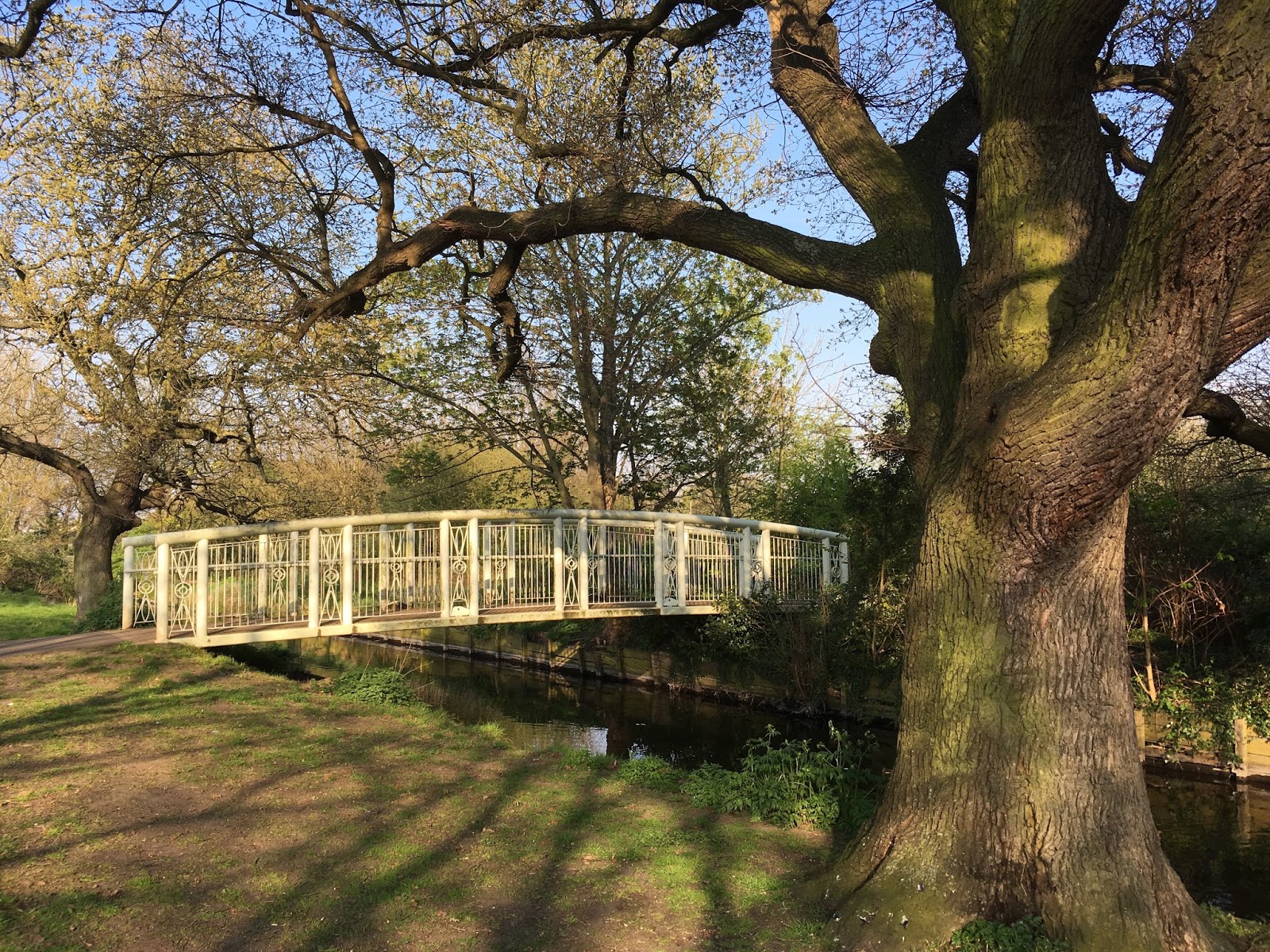
A small footbridge takes the walker across a tributary of the Crane
at Pevensey Nature Reserve

Thursday, 8 June 2017

Strangely like home


Whenever Jane and I visit the Melbourne suburb of St Kilda, I always feel at home. My brother-in-law lives in this area, and it is just down the road from Elwood where he and Jane grew up. I don't know if he was consciously looking to get back to his roots, but strangely it is my own roots in Ladbroke Grove that St Kilda reminds me of the most.
There are other elements that contribute to this beyond the presence of family. The architecture is more low-rise, but it is rooted in the same late-Victorian period. The local train service through this part of Melbourne is an overground service, just like the kind that runs through the part of west London where I spent my childhood.
This simple confluence of elements - of nineteenth century architecture and an overground train network - always makes this place feel familiar to me when stepping off the train at Balaclava station. There is also graffiti art everywhere, not unlike the kind I used to see around the Westway and Portobello Road areas (much of Melbourne and its suburbs are covered in graffiti, mostly by fairly skilled hands), and this once working class area has been subject to the same process of gentrification as I have seen in London. How many people around the world, I wonder, if you say "Notting Hill" to them immediately think of such bourgeois icons as Hugh Grant or David Cameron? The image of the area constructed over the last two decades does not describe the multicultural area I knew as a child, nor the working class slum known by a colleague of my dad who knew the area in the 1950s.


In many ways this is a description of the way random similarities can evoke a similar feel in otherwise disparate regions. There are obvious differences between Notting Hill and St Kilda, not least the latter's close proximity to the beach, the presence of the Melbourne tram network, a free community bus, backpackers hostels, ice addicts stumbling around the streets instead of winos, and the fact that one of the largest local communities is not Afro-Caribbean but Jewish. These are subtle differences, but they don't alter the curious manner in which, perhaps more than any other part of Australia I have seen so far, this area always feels to me the most strangely like home.
Why should this be? Why should I feel such familiarity for somewhere on the other side of the world?
It could be tied up to the way communities help shape places. The impressive new high rise architecture you find along the Yarra River likewise has a feel to me not unlike modern developments along the Thames here in London, or indeed those in cities like Dubai and Singapore. The feel of these landscapes understandably stems from their functionality, being designed for business and commerce rather than for people to live in, so naturally it is harder for individuals to put their own unique stamp on the character of an area.
The majesty of the new global riverside architecture is for me offset by a certain coldness, an aloofness which could be related to this very aspect of their nature. They are a spectacle, designed to draw people in and help them forget the mundane and messy landscapes of their ordinary lives and neighbourhoods, whilst forgetting that there is a beauty to the mundane and messy, and the landscapes that people make their own, etched with the lines of many daily struggles, over many years and lifetimes. (This is not to say that modern developments cannot be appropriated by ordinary people, as the skaters mecca along London's Southbank proves.)

What I experience in St Kilda is as much a feeling as a visual perception, tied up with my memories of the landscape of my childhood, which may be entirely separate from the reality of what that landscape has become, or is becoming. It is a nostalgia so subtle yet so specific that it can be evoked by the random assembly of elements in a city on the other side of the world.

Friday, 7 October 2016

Visiting Faraday House

Michael Faraday was the self-taught chemist and physicist who, among numerous other achievements, was responsible for the discovery of electricity. In 1833 he was made Fullerian Professor of Chemistry, an appointment for life at the Royal Institution, and worked as a government researcher investigating, among other things, the causes of a disastrous colliery explosion.


Faraday came from a working class family, and became a devout follower of the Sandemanian branch of the Church of Scotland. He was offered a knighthood in recognition of his services to science, but declined it, as it was against the Bible to accumulate riches and pursue worldly rewards like titles. Faraday preferred to remain "plain Mr Faraday to the end." He also refused on ethical grounds to help develop chemical weapons for use in the Crimean war.

Faraday House, at 37 Hampton Court Road, Middlesex, was formerly the Master Mason's House. The building was awarded to Faraday as a grace and favour dwelling in 1848, after the Prince Consort is said to have made representations on his behalf. He spent his last years here, and true to spirit, turned down an offer of burial in Westminster Abbey, opting instead to be interred in the dissenters' section of Highgate Cemetery.

You can see a pencil study I did from a bust of Faraday, which sits in the British Library, on my Instagram.

Thursday, 6 October 2016

The Stone Bomb Anti-Air War Memorial

"There are thousands of memorials in every town and village to the dead, but not one as a reminder of the danger of future wars." - Sylvia Pankhurst, 1936

Between the years 1924 and 1933 Sylvia Pankhurst lived with her Italian-born partner Silvio Corio at 126 High Road, Woodford Wells, Essex (what is now Woodford Green High Road, part of the north east London suburb of Woodford), opposite the Horse and Well pub, which still stands to this day.
In her lifetime Pankhurst was active in struggles for women's liberation, peace, socialism and, in her later years, the independence of Ethiopia from both Italian and British control. Corio was a journalist and painter who also worked at various times as a waiter and street trader, and for many years was active in the anarchist movement, first in Italy, then briefly France, before finally settling in London. In the early years of the twentieth century, before World War 1, he was part of the collective responsible for setting up a short-lived libertarian school near Euston.
The house Corio and Pankhurst moved into in 1924 was originally called Vine Cottage, but after settling in they re-named the four-room building Red Cottage, running a teashop for visitors making their way to nearby Epping Forest. Pankhurst herself had been a longtime visitor to Epping Forest. During WW1 she was fond of taking long walks with her ailing comrade Keir Hardie, the founding member and first leader of the Labour Party. 
Once settled at Red Cottage she began publishing the New Times and Ethiopia News, her contribution to the former British colonies' struggle for independence from another coloniser: fascist Italy.


In 1935, in what was then the building's front garden, a monument was unveiled by R Zaphiro, Secretary of the Imperial Ethiopian Legation London, of a stone bomb on a four-sided plinth. Across the four sides was inscribed a dedication: “To those who in 1932 upheld the right to use bombing aeroplanes this monument is raised as a protest against war in the air.”
The protest monument was designed and carved by the sculptor Eric Benfield, who has explained he was personally motivated by a strong feeling that: “Those [members of the league of nations] who had preserved bombing were politically and morally dead, and this was their gravestone.”
Visitors to the site may find it somewhat obscured by surrounding foliage.


During the 1930s the monument was subject to vandalism, at least one time by fascist Blackshirts. Sylvia, Silvio and their young son Richard, who was born during their time at Red Cottage, subsequently moved down the hill into a larger Victorian building called West Dene, which stood at 3 Charteris Road, next to Woodford station. West Dene has since been demolished to make way for flats, although in 1995 Redbridge council created a small park in the same vicinity which was named Pankhurst Green.


The building that housed Red Cottage was itself demolished in 1939 to make way for new houses. However, Benfield's unique protest monument of the stone bomb has remained, and was even awarded Grade II-listed status, mainly through the efforts of local activists who, during the 1980s, made the area a venue for peace picnics. So it is thanks to their efforts that the quote I used at the beginning of this article is not strictly true. There is still at least one monument that warns of the danger of future wars.
A moderately steep hill connects the Pankhurst Green in Woodford town centre with the busy road at the top where you will find the stone bomb memorial, but it is certainly worth the visit to bear witness to such a unique monument.

Wednesday, 22 June 2016

A ride through the Heathrow villages


The River Crane passes through Cranford on its journey south to join the Thames. 
Berkley Meadows can be seen in the background of this pic

This is the record of a journey I made by bicycle in early May of this year, as research for a new project I am working on. The spring was just starting to give way to summer, so there were still a few trees bursting with blossom, but by now most were fully in leaf.

I followed the rough path of the Crane Valley, travelling north. The Crane is so-called because it is forged by the river of the same name, which back in the nineteenth century was a dumping ground for industrial pollutants from, among other things, a local gunpowder factory. The river has been cleaned up in recent years and is now increasingly a haven for wildlife.


Striking suburban architecture at the junction in Cranford 
(there are four sets of these faux medieval towers on each side of the intersection)

Continuing northwards I arrived at Cranford, a suburban town which is part of the London borough of Hounslow, and apart from the striking architectural features at one of its main junctions also includes the stunning Avenue Park. A beautifully maintained expanse of leafy colour, the park also has a very well equipped children's play area. What surprised me the most however was the free, open air gym equipment. 


One of many pieces of exercise equipment in the open air gym in Avenue Park

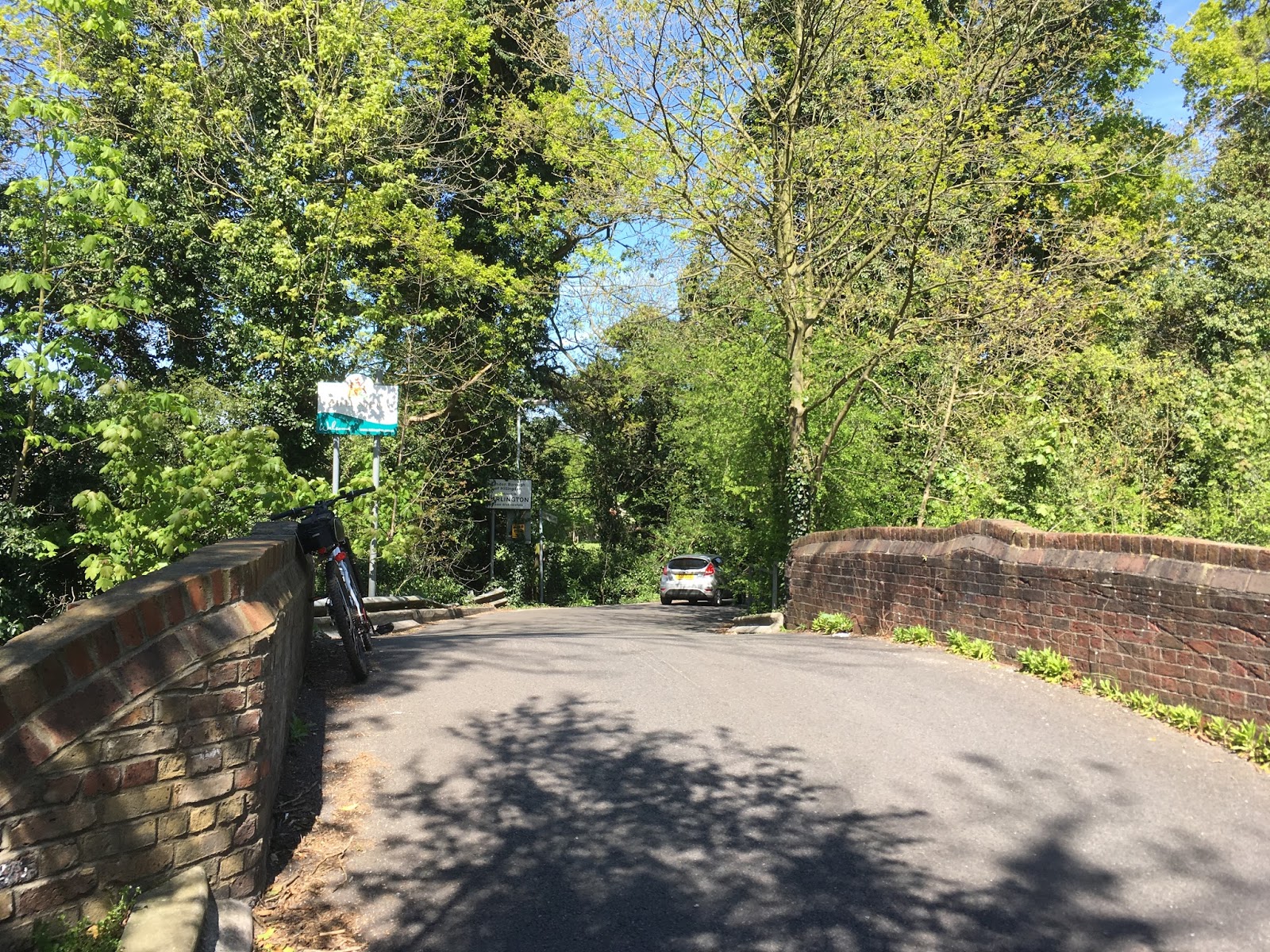
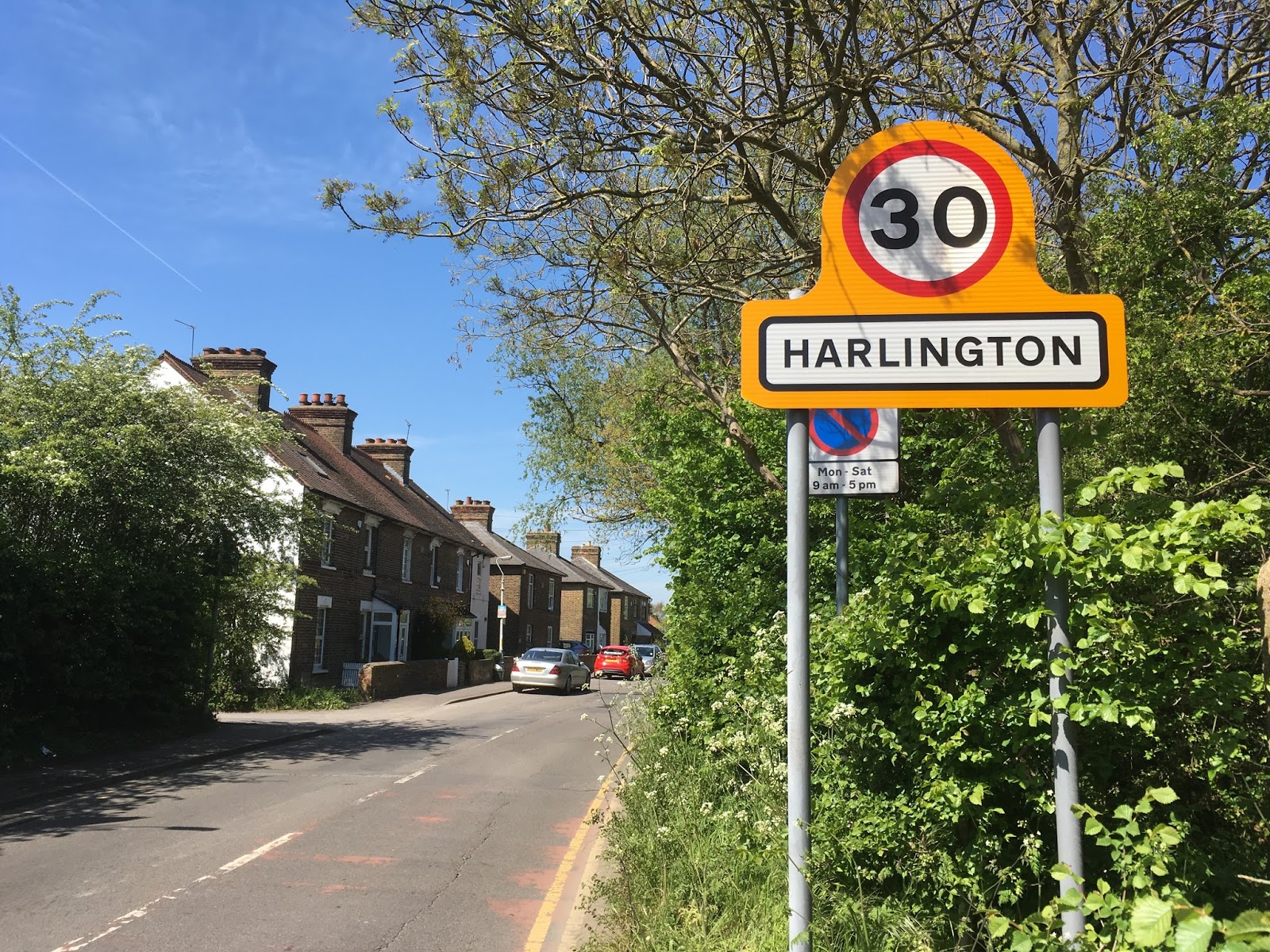
Heading west out of Cranford, and crossing the little stone bridge over the River Crane, I now found myself in Harlington, a small village which forms part of the neighbouring borough of Hillingdon, and includes the glorious landscapes of Cranford Country Park and Berkley Meadows. The latter takes its name from the wealthy family that once owned Cranford Manor.


The Bridge over the River Crane
(on the border between Hounslow and Hillingdon)


The journey west from Harlington to Sipson can seem repetitive at times, but as it is surrounded by fields on both sides it makes for an infinitely preferable route to riding along Bath Road, the busy dual carriageway which borders the airport to the south. 


The King William pub sits in the centre of Sipson, 
at the corner of the road to Harmondsworth

My journey took me through the small village of Sipson, which about ten years ago faced the prospect of complete destruction to make way for a third runway for the airport to the south. Due to a fierce campaign waged by a broad coalition of local campaigners and assorted eco warriors Sipson - including its church and local pub - still stands today.


A row of cottages in the heart of Harmondsworth village


On the road leading out of Harmondsworth village to the nearby Harmondsworth Moor

I ended the ride on this particular day in Harmondsworth village, which I still find striking in its traditional charm. There is a lot of beauty in this region, and I would urge anyone reading this to take the time to experience it themselves.

More doodles to follow soon.