Pages

Friday, 7 October 2016

Visiting Faraday House

Michael Faraday was the self-taught chemist and physicist who, among numerous other achievements, was responsible for the discovery of electricity. In 1833 he was made Fullerian Professor of Chemistry, an appointment for life at the Royal Institution, and worked as a government researcher investigating, among other things, the causes of a disastrous colliery explosion.


Faraday came from a working class family, and became a devout follower of the Sandemanian branch of the Church of Scotland. He was offered a knighthood in recognition of his services to science, but declined it, as it was against the Bible to accumulate riches and pursue worldly rewards like titles. Faraday preferred to remain "plain Mr Faraday to the end." He also refused on ethical grounds to help develop chemical weapons for use in the Crimean war.

Faraday House, at 37 Hampton Court Road, Middlesex, was formerly the Master Mason's House. The building was awarded to Faraday as a grace and favour dwelling in 1848, after the Prince Consort is said to have made representations on his behalf. He spent his last years here, and true to spirit, turned down an offer of burial in Westminster Abbey, opting instead to be interred in the dissenters' section of Highgate Cemetery.

You can see a pencil study I did from a bust of Faraday, which sits in the British Library, on my Instagram.

Thursday, 6 October 2016

The Stone Bomb Anti-Air War Memorial

"There are thousands of memorials in every town and village to the dead, but not one as a reminder of the danger of future wars." - Sylvia Pankhurst, 1936

Between the years 1924 and 1933 Sylvia Pankhurst lived with her Italian-born partner Silvio Corio at 126 High Road, Woodford Wells, Essex (what is now Woodford Green High Road, part of the north east London suburb of Woodford), opposite the Horse and Well pub, which still stands to this day.
In her lifetime Pankhurst was active in struggles for women's liberation, peace, socialism and, in her later years, the independence of Ethiopia from both Italian and British control. Corio was a journalist and painter who also worked at various times as a waiter and street trader, and for many years was active in the anarchist movement, first in Italy, then briefly France, before finally settling in London. In the early years of the twentieth century, before World War 1, he was part of the collective responsible for setting up a short-lived libertarian school near Euston.
The house Corio and Pankhurst moved into in 1924 was originally called Vine Cottage, but after settling in they re-named the four-room building Red Cottage, running a teashop for visitors making their way to nearby Epping Forest. Pankhurst herself had been a longtime visitor to Epping Forest. During WW1 she was fond of taking long walks with her ailing comrade Keir Hardie, the founding member and first leader of the Labour Party. 
Once settled at Red Cottage she began publishing the New Times and Ethiopia News, her contribution to the former British colonies' struggle for independence from another coloniser: fascist Italy.


In 1935, in what was then the building's front garden, a monument was unveiled by R Zaphiro, Secretary of the Imperial Ethiopian Legation London, of a stone bomb on a four-sided plinth. Across the four sides was inscribed a dedication: “To those who in 1932 upheld the right to use bombing aeroplanes this monument is raised as a protest against war in the air.”
The protest monument was designed and carved by the sculptor Eric Benfield, who has explained he was personally motivated by a strong feeling that: “Those [members of the league of nations] who had preserved bombing were politically and morally dead, and this was their gravestone.”
Visitors to the site may find it somewhat obscured by surrounding foliage.


During the 1930s the monument was subject to vandalism, at least one time by fascist Blackshirts. Sylvia, Silvio and their young son Richard, who was born during their time at Red Cottage, subsequently moved down the hill into a larger Victorian building called West Dene, which stood at 3 Charteris Road, next to Woodford station. West Dene has since been demolished to make way for flats, although in 1995 Redbridge council created a small park in the same vicinity which was named Pankhurst Green.


The building that housed Red Cottage was itself demolished in 1939 to make way for new houses. However, Benfield's unique protest monument of the stone bomb has remained, and was even awarded Grade II-listed status, mainly through the efforts of local activists who, during the 1980s, made the area a venue for peace picnics. So it is thanks to their efforts that the quote I used at the beginning of this article is not strictly true. There is still at least one monument that warns of the danger of future wars.
A moderately steep hill connects the Pankhurst Green in Woodford town centre with the busy road at the top where you will find the stone bomb memorial, but it is certainly worth the visit to bear witness to such a unique monument.

Tuesday, 16 August 2016

You can now have my artwork on your phone case...

...and travel mugs, notebooks etc.

Yes, I now have a Red Bubble account. Just search for 'RussMcP' on Red Bubble or use the link below:


The current images on there at the moment are older pieces which have been sitting on the back burner, simply because they didn't fit with the tone of work I was producing at the time for comics publishers. I will be adding newer pieces in the coming weeks and months, so remember to check back there for updates.

Wednesday, 22 June 2016

A ride through the Heathrow villages


The River Crane passes through Cranford on its journey south to join the Thames. 
Berkley Meadows can be seen in the background of this pic

This is the record of a journey I made by bicycle in early May of this year, as research for a new project I am working on. The spring was just starting to give way to summer, so there were still a few trees bursting with blossom, but by now most were fully in leaf.

I followed the rough path of the Crane Valley, travelling north. The Crane is so-called because it is forged by the river of the same name, which back in the nineteenth century was a dumping ground for industrial pollutants from, among other things, a local gunpowder factory. The river has been cleaned up in recent years and is now increasingly a haven for wildlife.


Striking suburban architecture at the junction in Cranford 
(there are four sets of these faux medieval towers on each side of the intersection)

Continuing northwards I arrived at Cranford, a suburban town which is part of the London borough of Hounslow, and apart from the striking architectural features at one of its main junctions also includes the stunning Avenue Park. A beautifully maintained expanse of leafy colour, the park also has a very well equipped children's play area. What surprised me the most however was the free, open air gym equipment. 


One of many pieces of exercise equipment in the open air gym in Avenue Park

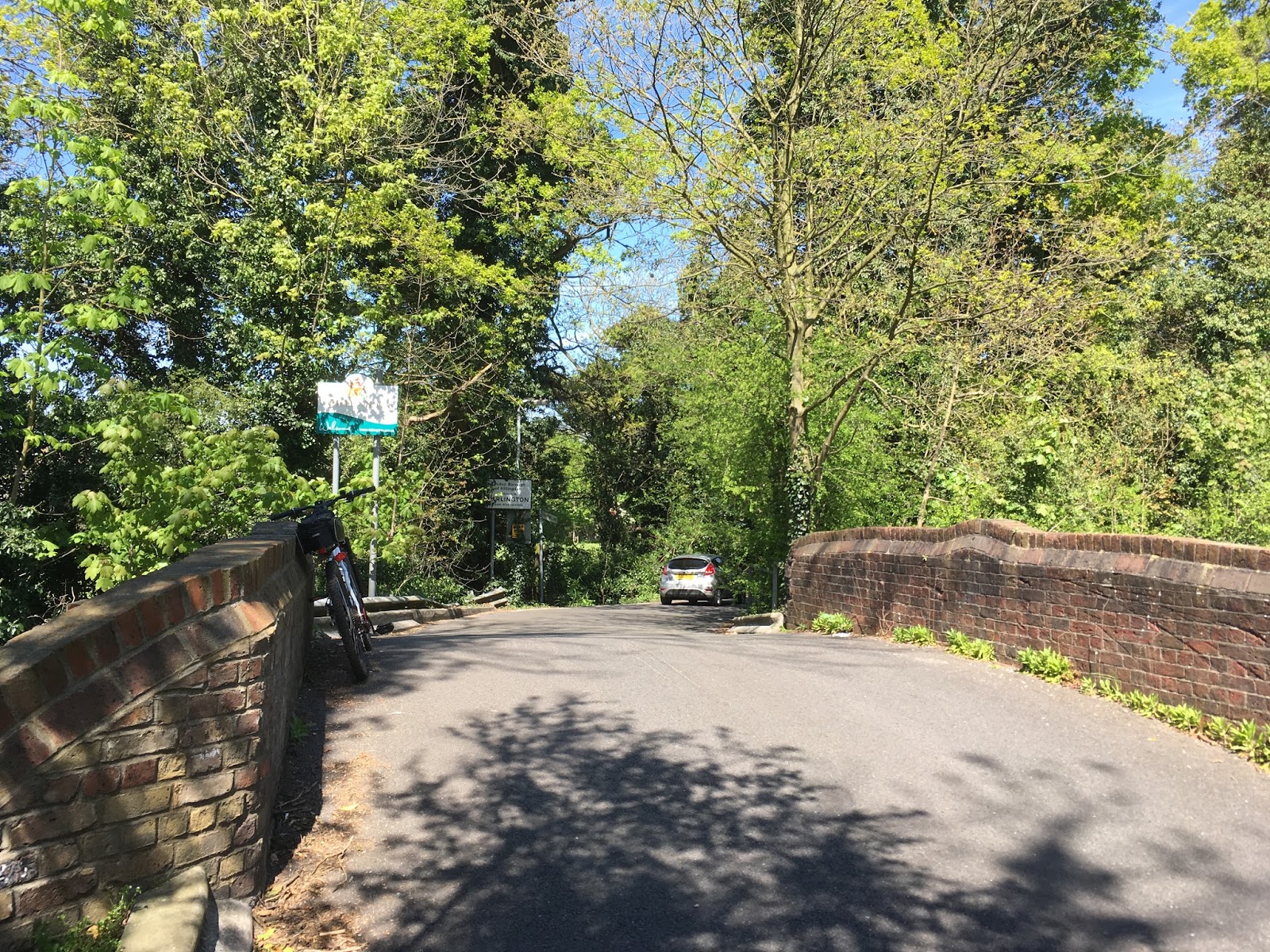
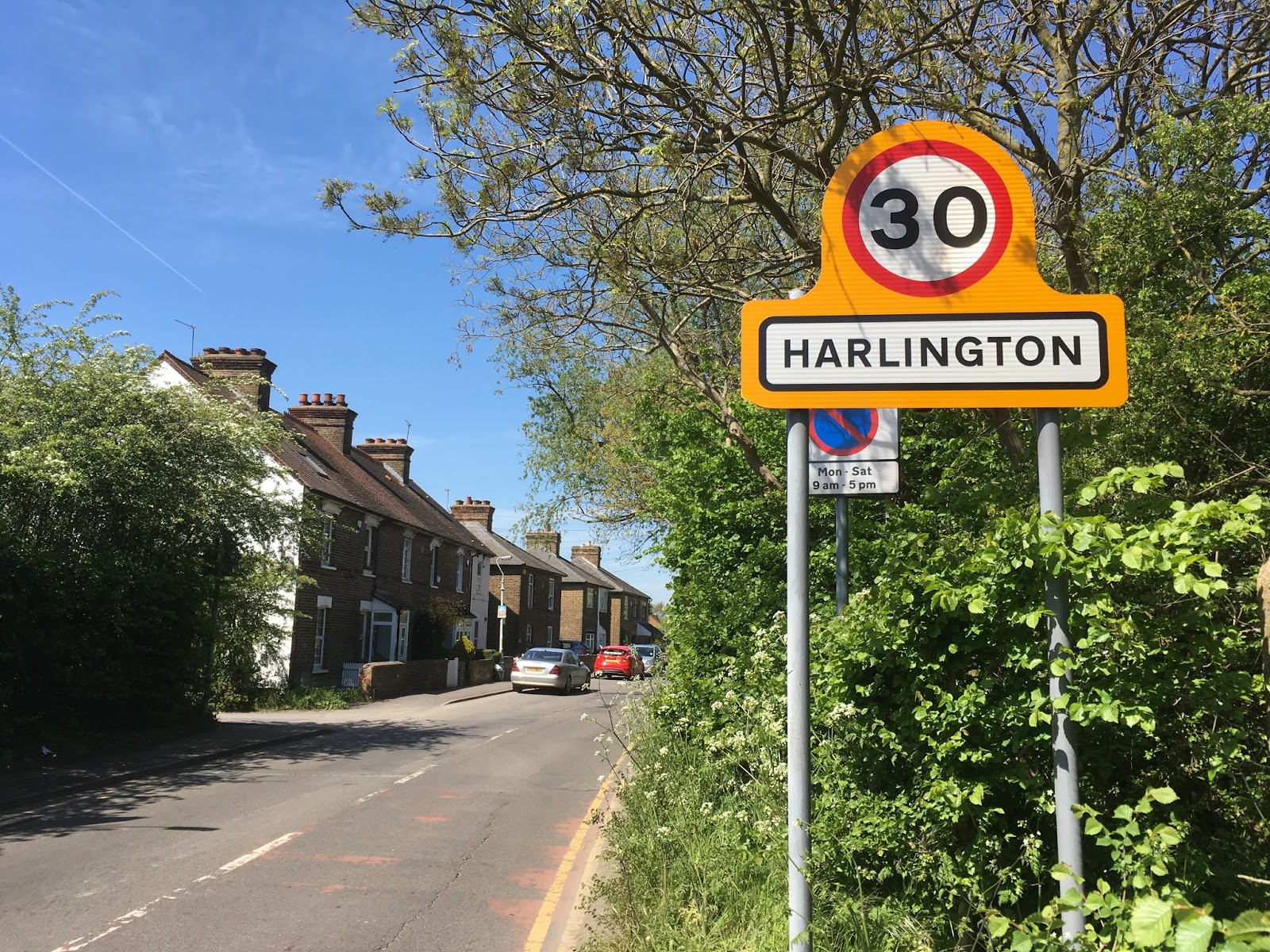
Heading west out of Cranford, and crossing the little stone bridge over the River Crane, I now found myself in Harlington, a small village which forms part of the neighbouring borough of Hillingdon, and includes the glorious landscapes of Cranford Country Park and Berkley Meadows. The latter takes its name from the wealthy family that once owned Cranford Manor.


The Bridge over the River Crane
(on the border between Hounslow and Hillingdon)


The journey west from Harlington to Sipson can seem repetitive at times, but as it is surrounded by fields on both sides it makes for an infinitely preferable route to riding along Bath Road, the busy dual carriageway which borders the airport to the south. 


The King William pub sits in the centre of Sipson, 
at the corner of the road to Harmondsworth

My journey took me through the small village of Sipson, which about ten years ago faced the prospect of complete destruction to make way for a third runway for the airport to the south. Due to a fierce campaign waged by a broad coalition of local campaigners and assorted eco warriors Sipson - including its church and local pub - still stands today.


A row of cottages in the heart of Harmondsworth village


On the road leading out of Harmondsworth village to the nearby Harmondsworth Moor

I ended the ride on this particular day in Harmondsworth village, which I still find striking in its traditional charm. There is a lot of beauty in this region, and I would urge anyone reading this to take the time to experience it themselves.

More doodles to follow soon.
 

Saturday, 30 April 2016

Corporate Watch Pose Alternatives to Capitalism

How many times do you hear people say something like: "Look, I know capitalism isn't perfect, but what are the alternatives?"

To go some way towards answering this question, Corporate Watch UK have collected an interesting and illuminating collections of articles and reports in the Alternatives section of their website. Here you will find articles on the worker-run fair trade food cooperative Zaytoun - which aims to give a fair deal to Palestinian farmers - and democratic confederalism in Kurdistan, as well as analysis of the Eurozone crisis and much more.

It's well worth a visit, and not just for the amazing artwork on display. 

Wednesday, 13 April 2016

Art for Spring


Some 'fineliner' drawings which attempt to capture the feeling of hope, optimism and renewed life that often accompanies the return of spring (in the northern hemisphere).


You can see more drawings like this on my Instagram.