Pages

Thursday, 24 March 2016

Incredible Edible Wild Plants of Spring

There's a few really good plants which pop up in the UK/WISE Isles around this time of the year which make really nice herbal teas. Strangely, these well known plants have often been maligned and ignored as weeds, but it is as pleasant and rewarding to go foraging for these plants in the springtime as it is to go blackberry picking in autumn.


It's generally good advice to only pick stuff you can confidently identify. If you have any doubt, leave it. It's also good to avoid stuff that grows too close to the sides of roads, as they may contain more toxins. And wash everything before you consume it.

I took the picture above on Barnes Common, an area of west London which has remained beautifully underdeveloped on account of the land's marshy, flood-prone quality. While it has little value for property developers it maintains great value to the local ecology. The main plant in the photo is a dandelion, which has just begun to flower. 

Now, its generally best to pick dandelion leaves before it flowers, as afterwards it can develop a more bitter flavour. Some people boil them for about 5-10 minutes to reduce the bitterness of raw dandelion leaves. The leaves make a nice peppery addition to salads, while the flowers, as rich in vitamin A and C as the leaves, can form the basis of herbal teas and even be brewed into dandelion wine. Later in the year the roots can be dug up, washed, dried, roasted and then grated up to create a caffeine-free coffee substitute. At present I mostly use the leaves.

I understand that if you take the fresh root as a tea it works particularly well for detoxifying the purifying the liver, kidneys, gall bladder and regular bladder. 

The other plant you may be able to see in the photo are the long, thin leaves of the cleaver (or goosegrass), which is also called "sticky willy" because it has a velcro-like texture which probably helps it cling to the fur or feathers of birds and other animals. You can chew it fresh or drink it in hot or cold infusions, and it has a pleasantly refreshing flavour, as well as providing a rich source of natural vitamin C, as well as the same cleansing properties as dandelion. The seeds of the cleaver provide a coffee substitute.

The value of the wild plants that pop up in springtime are as cleansing, detoxifying agents, which means you may have to visit the toilet soon after drinking, so make sure you take precautions. This is why the ancient folk name for the dandelion was "piss-a-bed."


Some cleavers I picked during a wild food walk in Sipson


Tuesday, 22 March 2016

Yorkley Court Fundraiser

Related to my previous post on here, I wanted to share this powerful song by Muddy Summers & The Dirty Field Whores. It is filled with beautiful music and fiery lyrics, and has been recorded as a fundraiser for the more than twenty human beings who have been made homeless by the eviction of Yorkley Court Community Farm, to help them rebuild their homes and lives.


If you have the cash then do please click along to https://muddysummers.bandcamp.com/track/landgrabber-for-yccf and donate what you can.

If you don't have the cash you can still share the song with anyone you know who might enjoy it.

One love x

Wednesday, 16 March 2016

The need to reclaim the fields

So, Yorkley Court Community Farm, the land occupation down near Lydney in the Forest of Dean, is under siege. The possession order has finally been served, and the land rights activists involved have now apparently scattered into the surrounding woods.
Within the current framework of UK land law, this was all sadly inevitable, in spite of several instances of successful eviction resistance at the site over the last couple of years, it now seems that the prime movers will need to find a new site or fresh tactics for highlighting the gross inequalities of land distribution in England and Wales.
Sadly, I was never in a position to visit Yorkley Court. Now it seems I never will. So it goes.
One of the values of occupations like this is not necessarily their permanence or longevity, although undoubtedly more can be achieved within a given community over a longer time frame, nevertheless a feeling of permanence may inevitably run the risk of contributing to a sense of entrenchment both in membership and imagination, as members become more fixated on the day to day running of the space and less on challenging the dominant culture.
What matters is the example of another way.
This is as true of Yorkley Court as it was of other land occupations of the last five years or so, including some I have visited and reported on here and elsewhere such as the Hounslow Community Land Project and Runnymede Eco Village. Where else can people go to find ordinary women, children and men, no different from themselves, who have chosen instead of endlessly theorising or petitioning for a better and more equitable world, to create a working model in the here and now? By the very nature of their work they create a literal 'demonstration' of an alternative, more ecological and liberated future, that any visitor can bear witness to. Some passersby may be so inspired they even choose to become a part of it themselves.
I have little doubt that those who participate, at whatever level, in experiments such as this remain forever changed by the experience, their awareness of the relative strengths and weaknesses of this way and life informed by their own direct experience rather than any second-hand testimony such as this.

Wednesday, 17 February 2016

Radical History: The (Occupied) Cambridge Arms Pub


There used to be a pub at 42 Cambridge Road in Kingston-upon-Thames, Surrey (overlooking the Cambridge Estate) which ceased trading sometime around the millennium. It was called, imaginatively, The Cambridge Arms. All you'll find there now are a small block of modern, fairly unremarkable looking flats.

However, in its fallow period, which probably would have been in about 2004 or so, the pub was squatted, the ground floor painted red with the words "BUY SECOND HAND" painted in bold white letters across the front.

Although I never met any of the residents, I understood the message, and this may have been what made me decide to take a photo while passing by one day.

The image above is an embellished rendition made using some image manipulation software like Photoshop. I have included it here to create a semi-permanent record of a highly transitory and easily overlooked period in history. If anyone passing by this blog has any memories of the building as a pub, or even as a squat, you are welcome to share them below.

Wednesday, 27 January 2016

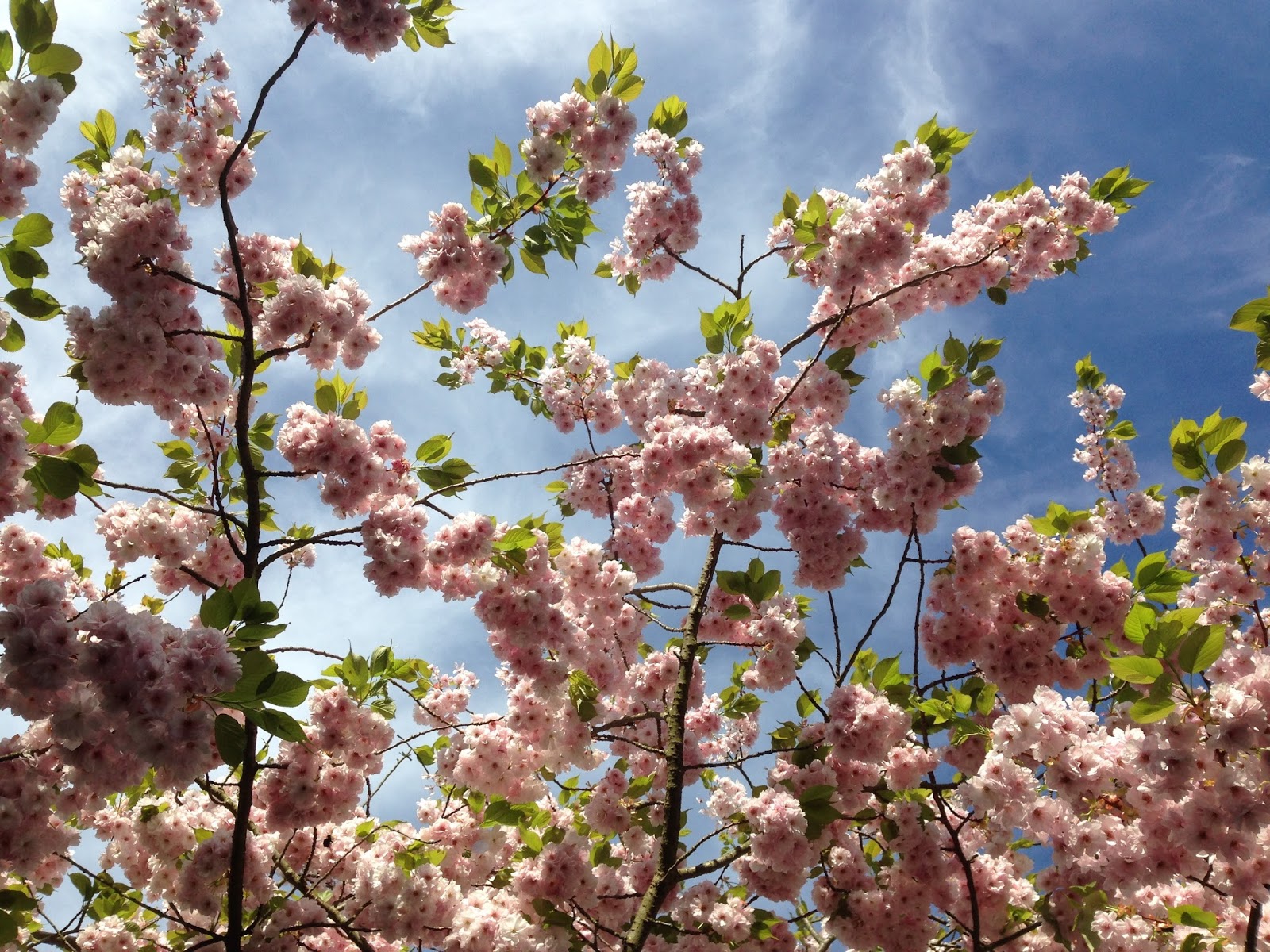
Blossoms in Teddington

For me, one of the most beautiful times of the year is springtime, when the whole world appears to be bursting with exuberant life and colour. I have seen some blossoms and bulbs emerging already this year, which is somewhat concerning (along with blackberry picking, a traditionally autumnal activity, but one which I have been doing since 2011 in early August and even July).

To brighten things up until things revive fully, here are a series of photos taken in the south west London suburb of Teddington over the last two springtimes.


Even in the midst of death there is life. 
This picture was taken in Teddington Cemetery, which includes the final resting places of the author and market gardener R.D. Blackmore, the "fifth Beatle" Neil Aspinall, musician Art Wood, and many more.


Monday, 5 October 2015

Reflections on the recent eviction of Runnymede Eco Village

 
Runnymede Eco Village, which evolved peacefully on a few acres of steep, muddy, dilapidated woodland for more than three years, achieving an initially positive legal ruling in the High Court in June 2015, before losing a subsequent appeal in early September, was finally evicted, seemingly without notice and with a quite shocking but regrettably common degree of force, on the morning of Wednesday 16th September 2015.
 The alternative community had its roots in a land rights campaign called Diggers2012 which sought to highlight the deeply unequal nature of land ownership in the UK. They did this by reviving the spirit and tactics of the historical Diggers of 1649, also known as the True Levellers, a millenarian group created primarily by a former cloth merchant named Gerrard Winstanley. Along with a small group of like-minded people, Winstanley had sought to “make the earth a common treasury for all” by occupying wasteland at St George's Hill in Surrey, building rudimentary structures and sowing vegetables, and inviting all to come and join them. We know about their ideas because, living as he was in the early days of the free press, Winstanley was also a very active pamphleteer.
 As is so often the case, the eviction of Runnymede Eco Village demonstrated the disregard that some bailiffs seem to show towards persons and personal possessions. No attempt was made to spare even the beautiful 16th century-style longhouse that had served as the main communal area for the community for example. Part of me always felt that, even if the residents were one day evicted, the longhouse could still have provided an interesting curiousity, either for visitors to the woods or for future residents at the top of the hill, but perhaps this was a naively hopeful expectation.
 The reality of what actually takes place during evictions of this nature is a disturbing reminder of what is required to create the “blank slate” necessary for more profit-oriented forms of development to take place.
 This may lead some to wonder if the surplus time and energy required (to destroy organic communities and protect private profits) is really worthwhile. Whilst property owners, or aspiring property owners, may think it is, and their attitudes may be shared consciously or unconsciously by those who accept the norms of the dominant culture without question (as being somehow "the best of all possible worlds" or simply "our way of life"), those with different desires may beg to differ, as the poet and former Runnymede resident Ben Cheal explains on his blog.

While there have been some attempts recently to address the issue of land rights north of the border in Scotland, given the increasingly authoritarian nature of the current Conservative administration, it remains a challenge to put forward issues of land redistribution on a national level in the rest of the country. This is not to say that there aren't people active in those struggles however, merely that such activity so far remains very grassroots.
 Prior to the creation of Diggers2012, for example, some of the chief protagonists had staged a one week occupation on part of Clapham Common in September 2011. Land and Freedom Camp, as it was called, was an attempt to highlight many of the same issues later raised by Diggers2012.
 The temporary nature of the Land and Freedom Camp may offer a more endurable model for future land rights campaigns, one that would perhaps circumvent the trauma commonly associated with evictions. Of course, for those more interested in pursuing an alternative lifestyle than campaigning exclusively for land reform such a shift in tactics may require a larger adjustment as they are forced to adopt a more nomadic life. However this may turn out to be not without its own appeal. It is worth remembering that nomadic, hunter gatherer societies have often demonstrated a remarkable longevity and environmental sustainability compared with more settled civilisations.
 One thing that becomes apparent with many fixed communities which come together in a spirit of protest is that the longer they persist the more the focus tends to shift over time, as different people come and go. This is less so in the case of occupied spaces like Faslane Peace Camp or Grow Heathrow, which have both maintained very clear campaign goals (against nuclear weapons and airport expansion respectively) over many years. In the case of more anarchic communities like Runnymede Eco Village its three year existence saw the focus of the community shift, as older members of Diggers2012 left and younger campaigners from the Love Activists group moved in.
 The Love Activists have been specifically focused on the related issues of housing and homelessness, which has been exacerbated by PSPO's (Public Space Protection Orders, which are used by local councils to criminalise homelessness and begging) and increasing gentrification, both symptomatic of the short-sighted focus of many politicians who remain intent on catering to the disengaged prejudices of the middle and upper classes.
 The Love Activists group first drew media attention for their short-lived occupation of an £80 million, grade 2 listed, offshore owned, former HSBC building in Charing Cross on 20th December 2014. This was part of their 'Homes Not Banks' campaign, a form of creative direct action intended to open the empty building up to the homeless of London for unconditional food and shelter. Undeterred by an eviction on Christmas Eve, they maintained a street kitchen on the pavement opposite the former bank well into the following January.
 The “hippies” who are focused more on stepping out of mainstream society often remain a persistent presence throughout such long-running protest camps, based as they are around maintaining an alternative community, a model of the kind of egalitarian world many of us might rather build for ourselves given sufficient time and space. The same could be said for many of the artists and poets seeking the freedom to create in a space where the pressure of money no longer holds sway.
 When the Runnymede Diggers were eventually evicted they carried the distinction of having maintained their peaceful occupation for twice as long as the historical Diggers of 1649. The group's community page on facebook had attracted over 1,800 likes and the community had a distinct culture of its own. While some evicted residents apparently held out in a disputed patch of woodland between the now enclosed, derelict campus site to the south and the National Trust-owned Runnymede Park to the north, other former residents have already hit the ground running.

The Four Seasons Community Cooperative, whose new community page attracted 136 likes in its first two days, held its first open meeting on Sunday 20th September 2015 at the newly occupied Oast House Adult Learning Centre in Staines, a council-owned property just along the River Thames which has apparently been empty for more than eight years. The current intention is to “pave the way toward a transition network” in the Staines area, and they have already launched a 38 Degrees community petition to Staines County Council, in an attempt to have the building they are presently occupying designated an Asset of Community Value.
 Those keen on campaigning on the front lines for a fairer system of land rights and more affordable housing, as well as those simply seeking an alternative, more liberated and ecologically sustainable life, will most likely roll on, come what may, learning skills at each new occupation. What I find most inspiring is the practical DIY approach and respect for individual freedom and autonomy at work in these spaces, together with the awareness that despite the violence of the eviction, the spirit of Runnymede will very likely be carried far and wide, the seeds needing only a little bit of fertile ground to grow. 
Anyone interested in learning more about the full spectrum of campaigns for a fairer and more sustainable distribution of land in the British Isles (or WISE Isles, if you will) may be interested in following the work of campaign groups like The Land Is Ours or the magazine The Land. 


Amended: June 3 2016

Wednesday, 29 July 2015

Zine Making Workshop in West London - Sunday 9th August

Anyone who likes the zine reviews I post sometimes, I just found out about this upcoming event from Transition Heathrow:

A zine drop-in workshop with OOMK. Participants will be invited to use various templates and collage materials to create their own future city zines to take away. There will be zines on display for participants to draw inspiration from.

Suggested donation – £2

Grow Heathrow, Vineries Close, Sipson, West Drayton UB7 0JG

Sunday 9th August, 13:00


Biographies

OOMK is a highly visual, handcrafted small-press publication. Printed biannually its content pivots upon the imaginations, creativity and spirituality of women. Each issue centres around different creative theme, with more general content exploring topics of faith, activism and identity. Studio OOMK is a design studio that specialises in bespoke booklet design, project documentation, exhibition design and live illustration. The studio is run by Sofia Niazi (illustrator and educator), Heiba Lamara (researcher) and Rose Nordin (graphic designer). Previous clients include the Museum of London, Southbank Centre, 3FF and the Migration Museum.
Other Asias challenges preconceived notions of Asia opening up new configurations of space, thought and discussion. We provide alternatives to corporate/NGO representations of Asia with cross-community and inter-continental discourse enhancing local and international knowledge distribution. Projects include exhibitions, plays, film screenings, talks, zines and performance work. Hamja Ahsan is an artist, activist, curator and Director of Other Asias. Helena Wee is an artist and curator. Fuad Ali is a researcher and creative producer.